First-ever Photos and Footage of Silver-backed Chevrotain Confirm First Rediscovery of Lost Mammal on Global Wildlife Conservation’s ‘Most Wanted’ List
For immediate release
November 11, 2019
Download images, video, paper proof and blog post
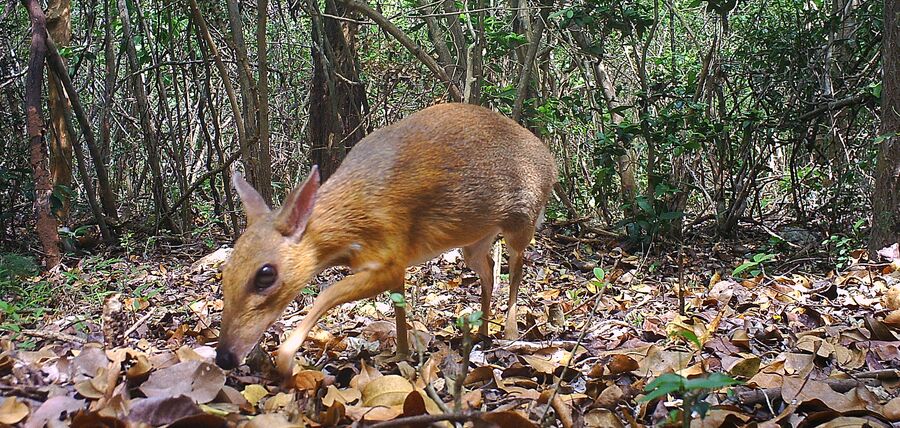
Global Wildlife Conservation and partners Southern Institute of Ecology and Leibniz Institute for Zoo and Wildlife Research have rediscovered a wildlife species lost to science since 1990 called a silver-backed chevrotain—a deer-like species that is the size of a rabbit, has a silver sheen, and has been hanging on in a region of Vietnam ravaged by poaching by snares. The silver-backed chevrotain, also called the Vietnamese mouse-deer, was last recorded more than 25 years ago and is the first mammal rediscovered on GWC’s list of top 25 most wanted lost species in the Search for Lost Species.
The rediscovery in southern Vietnam was published today, November 11, in scientific journal Nature Ecology & Evolution and is spurring efforts to protect the chevrotain and the other mysterious and extraordinary wildlife that shares its home in Vietnam.
“We had no idea what to expect, so I was surprised and overjoyed when we checked the camera traps and saw photographs of a chevrotain with silver flanks,” said An Nguyen, associate conservation scientist for GWC and expedition team leader. Nguyen is also field coordinator and PhD student with the Leibniz Institute for Zoo and Wildlife Research. “For so long this species has seemingly only existed as part of our imagination. Discovering that it is, indeed, still out there, is the first step in ensuring we don’t lose it again, and we’re moving quickly now to figure out how best to protect it.”
The silver-backed chevrotain was described in 1910 from four individuals collected from southern Vietnam. A Russian expedition in 1990 in central Vietnam collected a fifth individual. Scientists know almost nothing about the species’ general ecology or conservation status, making it one of the highest mammal conservation priorities in the Greater Annamites, one of GWC’s focal wildlands.
After a number of interviews with local villagers and government forest rangers who reported seeing a gray chevrotain—distinguishing the silver-backed chevrotain from the more common lesser chevrotain—the field team set three camera traps for five months in an area of southern Vietnam where locals indicated they may have seen the animal. This resulted in 275 photos of the species. The team then set up another 29 cameras in the same area, this time recording 1,881 photographs of the chevrotain over five months.
“The rediscovery of the silver-backed chevrotain provides big hope for the conservation of biodiversity, especially threatened species, in Vietnam,” said Hoang Minh Duc, head of the Southern Institute of Ecology’s Department of Zoology. “This also encourages us, together with relevant and international partners, to devote time and effort to further investigation and conservation of Vietnam’s biodiversity heritage.”
There are 10 known species of chevrotain in the world, primarily from Asia. Despite their nickname, chevrotains are neither mice nor deer, but the world’s smallest ungulates (hoofed mammals). They are are shy and solitary, appear to walk on the tips of their hooves and have two tiny fangs. Chevrotains typically weigh less than 10 pounds.
The chevrotain is one of a number of fascinating species that live in the diverse tropical forests of Southeast Asia, where some species have only been discovered in the last few decades. This includes the antelope-like saola (the Asian “unicorn”), which was only discovered in 1992 and that no biologist has seen in the wild. Animals in this area of the world, however, are victims of a devastating hunting technique—the use of cheap and homemade wire snares. The level of indiscriminate hunting in the region has led to widespread “empty forest syndrome” across Vietnam, pushing numerous Annamite species to the brink of extinction.
A team is now setting out to determine how large—and stable—this population of silver-backed chevrotains is, the wider distribution of the species, and understanding the threats to its survival. As part of the first-ever comprehensive survey on the species, the team will begin camera trap surveys this month in two additional areas. They will use all of the information that they gather to develop and implement a conservation action plan that strengthens enforcement and protection of the species across its range, building on the increased enforcement already put in place at the site of rediscovery.
“It is an amazing feat to go from complete lack of knowledge of the wildlife of the Greater Annamites 25 years ago, to now having this question mark of the silver-backed chevrotain resolved,” said Barney Long, GWC senior director of species conservation. “But the work is only beginning with the rediscovery and initial protection measures that have been put in place—now we need to identify not just a few individuals on camera trap, but one or two sites with sizable populations so that we can actually protect and restore the species.”
This project was made possible in part by the generous support of Wroclaw Zoo, Auckland Zoo, Mohamed bin Zayed Species Conservation Fund (Project 172515989), and the Gerald Singer Deer Research Grant provided by the Sainte Croix Biodiversité. Additional support was provided by Southern Institute of Ecology and the Leibniz Institute for Zoo and Wildlife Research.
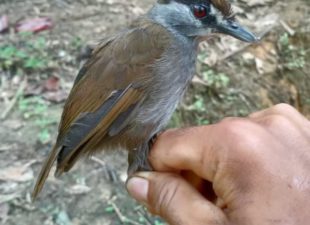
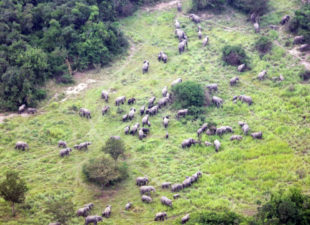
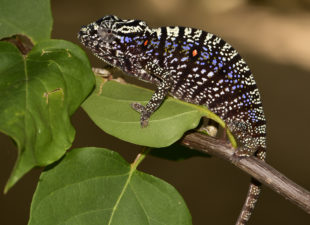
In addition to the silver-backed chevrotain, GWC has confirmed the rediscovery of three additional species from its 25 most wanted lost species list: Jackson’s climbing salamander in Guatemala, and both the Wallace’s giant bee and the velvet pitcher plant in Indonesia. GWC is awaiting the results of genetic testing to confirm the rediscovery of two additional most wanted lost species: the Fernandina Galápagos tortoise in the Galápagos, and the Pondicherry shark in India.
Support the Silver-backed Chevrotain
Now that we have found the Silver-backed Chevrotain, we don’t want to lose it to extinction.
Click here to donate to help set up an area-wide survey using trail cameras to inform a conservation action plan that will protect and recover this species.
# # #
Photo: Camera trap image of the lost Silver-backed Chevrotain in Vietnam. (Photo by the Southern Institute of Ecology/Global Wildlife Conservation/Leibniz Institute for Zoo and Wildlife Research/NCNP)
Download images, video, paper proof and blog post
Global Wildlife Conservation
GWC conserves the diversity of life on Earth by safeguarding wildlands, protecting wildlife and supporting guardians. We maximize our impact through scientific research, biodiversity exploration, habitat conservation, protected area management, wildlife crime prevention, endangered species recovery, and conservation leadership cultivation. Learn more at https://globalwildlife.org
Southern Institute of Ecology
Southern Institute of Ecology (SIE) is a member research institution of the Vietnam Academy of Science and Technology. SIE’s vision is to produce high quality, innovative research and application, advocacy, and training products in the field of integrated biodiversity conservation and community development and planning. More information on SIE can be found at http://www.sie.vast.vn/
Leibniz Institute for Zoo and Wildlife Research
The Leibniz Institute for Zoo & Wildlife Research (IZW) is an internationally renowned German research institute of the Leibniz Association. Its mission is to examine evolutionary adaptations of wildlife to global change and develop new concepts and measures for conservation. To achieve this, the Leibniz-IZW uses its broad interdisciplinary expertise in conducting research for conservation in close dialogue with the public and stakeholders.
Contact
Lindsay Renick Mayer
Global Wildlife Conservation
lrenickmayer@globalwildlife.org
202-422-4671
Robin Moore
Global Wildlife Conservation
rdmoore@globalwildlife.org
202-360-5339